
Changes to TRA skills assessments

 Trades Recognition Australia (TRA) has announced changes to the Trade Skills Assessment programs for TSS (TSS Skills Assessment Programs), OSAP (Offshore Skills Assessment Program), and TRS (Trades Recognition Services).
These changes come into effect on 1 March 2019 and apply to the following areas:
- Employment and training requirements for Pathway 1 assessments
- Assessment fees
- Evidence submission and payment process
- Postal applications
1. Employment and training requirements for Pathway 1 assessments
The amount of verifiable employment evidence a Pathway 1 applicant must submit for their nominated occupation has been changed as follows:
- Licensed trade with no formal training – 6 years’ work experience
- Licensed trade with formal training – 4 years’ work experience
- Non-licensed trade with no formal training – 5 years’ work experience
- Non-licensed trade with formal training – 3 years’ work experience.
Additionally, all applicants must have completed at least 12 months of employment in their nominated occupation in the three years prior to lodging their application.
Please note: ‘Formal training’ is defined as training that aligns with the national training standards in the applicant’s country of training.
2. Assessment fees
Fees for Trade Skills Assessments are now set by Trades Recognition Australia. Payment of these fees must be made directly to TRA. Information regarding the new fees is available here on our blog.
3. Evidence-submission and payment process
From 1 March 2019, VETASSESS requires new applications to include all required Stage 1 documentary evidence.
4. Postal application forms no longer accepted
VETASSESS will no longer accept postal applications. All applications must be submitted online.
Will these changes affect applicants who applied for their assessments before 1 March 2019?
No. These changes only affect assessments paid for on or after 1 March 2019.
Questions or concerns?
If you have any questions or concerns about these changes, please do not hesitate to contact us. You can either call us on +27 (0) 11 123 4274 or email us.
- Published in Immigration to Australia, News
Increase of skills assessment fees for Offshore Skills Assessment Program, TSS Skills Assessment Program and Trade Recognition
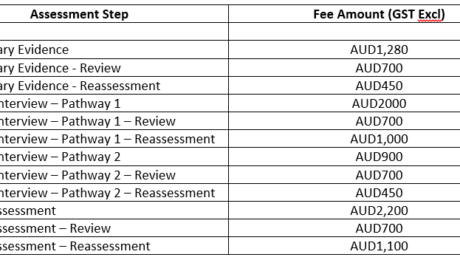
From 1 March 2019, skills assessments for the TSS Program (TSS Skills Assessment Program), OSAP (Offshore Skills Assessment Program) and TRS (Trades Recognition Services) will see an increase in fees.
The new fees
The following fees apply to the specific services which might be required in a skills assessment as of 1 March:

Please note: You won’t necessarily go through each of the steps listed above. The steps you have to complete would depend on your individual circumstances. For more information regarding your eligibility please contact us.
Skills assessment fees will now be paid directly to Trade Recognition Australia (TRA) through the TRA Online Portal
There is one other change coming into effect on 1 March with regards to fees. Going forward, you will pay your skills assessment fees directly to TRA through the TRA Online Portal.
Please note: There are also three other changes coming into effect with regards to skills assessments. Read more about these here.
How will TRA payments work?
To facilitate Online Portal payments, your chosen RTO (Registered Training Organisation) will provide you with an RTO assessment payment identifier code. This code must be used to make payment through the TRA Online Portal for the service you require. For example, a technical assessment, practical assessment, etc.
Intergate Emigration’s role
Your administrator at Intergate will assist you with payment of your skills assessment. Our adviser will establish the RTO to choose during your eligibility assessment and the administrator will facilitate the payment on your behalf on submission of your skills assessment.
Call us with questions or concerns
If you have any questions on or concerns about these fee increase and how they may affect you, please feel free to contact us.
- Published in Immigration to Australia, News
Top 10 benefits of studying in Australia


Australia attracts thousands of international students each year. The University of Melbourne alone has 30,000 students from other parts of the world!
But why do students choose to study in Australia? Let’s have a look:
1. Seven out of the top 100 universities in the world
The 2023 QS World University Rankings includes 38 Australian universities. Of those 38 universities, seven is in the top 100.
That’s incredible considering there are just over 1,400 universities in the QS World University Rankings!
Australia’s top 10 universities are:
- Australian National University (30)
- University of Melbourne (33)
- University of Sydney (41)
- University of New South Wales (45)
- University of Queensland (50)
- Monash University (57)
- University of Western Australia (90)
- University of Adelaide (109)
- University of Technology Sydney (137)
- University of Wollongong (185)
2. World-class education
Australian universities offer programs and courses that are recognised globally. The Australian Qualifications Framework (AQF) is largely to thank for this.
The AQF allows students to easily move through the education system in Australia and provide an easy way for other countries to recognise qualifications and to issue the comparable qualifications.
It should also be mentioned that Australian universities offer modern facilities, advanced curriculums, and specialist funds for research and development.
3. You can study just about anything
The more than 40 universities across Australia offer hundreds of courses and degrees to choose from. You’ll be able to find a qualification in almost every discipline and field of study.
4. You’re protected by TEQSA and the ESOS Act
Australia’s Tertiary Education Quality and Standards Agency, or TEQSA, acts as a national regulatory and quality agency for higher education. The Agency monitor quality and regulate university and non-university higher education providers against a set of standards developed by the independent Higher Education Standards Panel.
In addition, the Education Services for Overseas Students Act (ESOS Act) sets nationally consistent standards for the delivery of courses to overseas students.
According to Australia’s Department of Education and Training, the Act ‘protects and enhances Australia’s reputation for quality education, provides tuition protection and supports the integrity of the student visa program’.
5. Many scholarships for international students
If you think studying in Australia is not within reach , you’ll be glad to hear that international students have many scholarships, grants, and bursaries available to them. These are offered by the Australian government, education institutions, and a number of public and private organisations.
Three of the major scholarships in Australia are:
- Australia Awards
- Australian Government Research Training Program (RTP)
- Australia APEC Women in Research Fellowship
6. Superb research opportunities
Australia invests heavily in research and has produced outstanding research in various fields.
Well-known discoveries that have come out of Australia include penicillin, WiFi, the ultrasound machine and the flight data recorder or ‘black box’. W
As a student in Australia, you’ll be able to take advantage of the impressive technology and research resources that made these inventions possible.
7. High quality of life
Australia consistently scores well in surveys and studies that measure quality of life.
- Australia outperforms the OECD averages in the OECD’s Better Life Index.
- In 2021, Adelaide, Perth, Melbourne and Brisbane were among the world’s top 10 most liveable cities in the The Global Liveability Report.
- Australia is in 5th place on Numbeo’s 2022 Quality of Life Index, placing above Iceland, Germany, Austria, New Zealand, and Norway.
- Australia comes in at 5th place on the US News Quality of Life Ranking.
8. You can work while you study
Australia allows student visa holders to work while they’re studying.
Usually, this means working a maximum of 40 hours per fortnight. However, the Department of Home Affairs made a temporary concession in 2022 that allows students to work unlimited hours in any sector.
Please also keep in mind that you may only work once your course has commenced and only while your course is in session.
9. The opportunity to work in Australia after your studies
The Temporary Graduate Visa (subclass 485) offers international students who’ve studied in Australia for at least two years the opportunity to apply for temporary permission to work in Australia.
The Subclass 485 visa has two streams under which you can apply, and depending on which stream you qualify for your visa will be valid for either 18 months or up to four years.
10. Natural beauty and perfect weather
Any list of the benefits of studying in Australia won’t be complete without mentioning the country’s many natural wonders and sunny days.
You can visit the Great Barrier Reef, the Kakadu National Park, the Tasmanian Wilderness and Fraser Island.
The sunny weather allows for many days spent outside, being active. Of course winter does happen, but it’s not nearly as severe as in other parts of the world.
Convinced by the benefits of studying in Australia? Call us!
If Australia seems to be the place to further your education, please feel free to contact us to discuss your options. Our licensed advisors have the answers and expertise you need.
- Published in Immigration to Australia, Studying in Australia
Australian government lists 117 occupations in NT that needs foreign workers

 The Australian government has released a list of 117 occupations as part of a new scheme that enables Australian employers to recruit from overseas as well as offers successful immigrants the opportunity to gain permanent residency.
The main condition? You have to be willing to live in the Northern Territory for at least three years.
The Northern Territory is perhaps not Melbourne or Sydney, but it is home to Australia’s famed Outback and residents are said to enjoy a laid-back lifestyle.
Interested? Then continue reading to find out more…
The scheme in summary
This brand-new scheme is called the Northern Territory Designated Area Migration Agreement – or DAMA, for short.
The DAMA allows NT (Northern Territory) employers to sponsor skilled and semi-skilled overseas workers for positions they are unable to fill with local workers.
What visa do you qualify for?
Overseas workers who are successful in their visa applications will receive a Temporary Skill Shortage visa (subclass 482) under the Labour Agreement stream.
Can applicants apply independently?
No, it is not allowed. The NT DAMA is an employer-sponsored visa program, which means you cannot apply for a visa independently. An eligible business operating in the NT must sponsor you, i.e. undertake to employ you.
What are the qualifying criteria?
You must be under the age of 45, meet the English language requirement, and have the skills and qualifications required by the employers for the advertised position. You must also be able to meet any and all other requirements of the subclass 482 visa.
Is permanent residency guaranteed?
No, it is not. You must still meet the eligibility requirements for permanent residency under the NT DAMA.
Is there an age limit?
The subclass 482 does not have an age limit, but you should be aware of the fact that you must be under the age of 50 when applying for permanent residency.
What types of jobs are on the list?
The list of 117 occupations ranges from skilled professions, such as engineers and mechanics, to more common occupations, such as caregiving and hairdressing.
You can view the full list occupations here or continue scrolling to the bottom of this article to view the list.
Can Intergate Emigration help?
As this is an employer-sponsored visa, Intergate can assist you once you have secured a job offer from an eligible employer. You are more than welcome to either call us on 011 234 4275 or to email us for assistance at that stage.
The full list of occupations
This is the bit you’ve been waiting for – the 117 jobs on the DAMA list. Here they are:
Accountant (General)
Accounts Clerk
Aged or Disabled Carer
Agricultural and Horticultural Mobile Plant Operator
Aeroplane Pilot
Airconditioning and Refrigeration Mechanic
Aircraft Maintenance Engineer (Avionics)
Aircraft Maintenance Engineer (Mechanical)
Aquaculture Farmer
Arborist
Automotive Electrician
Baker
Bar Attendant (Supervisor)
Barista
Beauty Therapist
Beef Cattle Farmer
Bookkeeper
Bus Driver
Butcher or Smallgoods Maker
Cabinetmaker
Cabler (Data and Telecommunications)
Café or Restaurant Manager
Carpenter
Chef
Chief Executive or Managing Director
Childcare Worker
Childcare Centre Manager
Civil Engineering Technician
Community Worker
Conference and Event Organiser
Cook
Cook (Specialist Ethnic Cuisine)
Customer Service Manager
Crowd Controller
Deckhand
Dental Assistant
Diesel Motor Mechanic
Disabilities Services Officer
Diver
Early Childhood (Pre-primary School) Teacher
Earthmoving Plant Operator (General)
Earth Science Technician
Electrical Linesworker
Electronic Instrument Trades Worker (General)
Excavator Operator
Facilities Manager
Family Day Care Worker
Family Support Worker
Fitter (General)
Fitter and Turner
Fitter-welder
Floor Finisher
Flying Instructor
Forklift Driver
Fruit or Nut Grower
Gaming Worker
Hair or Beauty Salon Manager
Hairdresser
Hardware Technician
Hotel or Motel Manager
Hotel or Motel Receptionist
Hotel Service Manager
ICT Customer Support Officer
ICT Support Technicians nec
Interpreter
Landscape Gardener
Licensed Club Manager
Linemarker
Management Accountant
Marketing Specialist
Metal Fabricator
Mixed Crop and Livestock Farmer
Mixed Crop Farmer
Mixed Livestock Farmer
Motor Mechanic (General)
Motor Vehicle Parts and Accessories Fitter (General)
Motor Vehicle or Caravan Salesperson
Motor Vehicle Parts Interpreter
Motorcycle Mechanic
Nursing Support Worker
Office Manager
Out of School Hours Care Worker
Panelbeater
Personal Care Assistant
Pharmacy Technician
Plumber (General)
Pressure Welder
Program or Project Administrator
Property Manager
Recreation Officer
Residential Care Worker
Retail Manager (General)
Retail Supervisor
Sales and Marketing Manager
Sheetmetal Trades Worker
Ship’s Engineer 1
Ship’s Master
Small Engine Mechanic
Sound Technician
Supply and Distribution Manager
Taxation Accountant
Telecommunications Cable Jointer
Telecommunications Linesworker
Telecommunications Technician
Therapy Aide
Tour Guide
Truck Driver (General)
Vegetable Grower
Vehicle Painter
Veterinary Nurse
Waiter Supervisor
Waste Water or Water Plant Operator
Web Administrator
Web Designer
Welder (First Class)
Welfare Worker
Youth Worker
- Published in News, Our latest posts
New visa for parents of Australian migrants in 2019

 Migrants to Australia will be delighted to learn that Australia is introducing a Temporary Sponsored Parent visa in 2019. This visa will present parents and grandparents with a new pathway to reunite with families.
More about this visa
The Temporary Sponsored Parent visa will allow parents to visit their families in Australia for a continuous period of up to 5 years.
Minister for Immigration, Citizenship and Multicultural Affairs David Coleman said the visa demonstrated the Government’s commitment to migrant communities.
“This new visa will help families reunite and spend time together,” Mr Coleman said. “It will provide a new pathway for parents and grandparents to visit their families in Australia, which will deliver great social benefits to the Australian community.”
As the name of the visa suggest, migrants will act as sponsors for their parents. Sponsors will act as a financial guarantor for any outstanding public health costs incurred by the visa holder while in Australia.
“This new visa will ensure family reunions are possible for many migrant families across Australia, while protecting taxpayers with strict guidelines to ensure all public health debts including hospital and aged care fees are recovered by the Australian Government,” Mr Coleman said.
The application process
The application will be a two-step process. There will first be an assessment of the sponsor and only once the sponsor is approved can the visa application be lodged.
It is also important to note that according to the regulations of the visa, each migrant household will only be able to sponsor one set of parents. This regulation was criticized by the Labour Party as well as migrant groups, as it would force families to choose which parents or in-laws they reunite with.
Applications open in the first half of 2019
Applications for the Temporary Sponsored Parent visa open in the first half of 2019. No official date has been released at time of writing.
If you and your parents would be interested in applying for this visa, we suggest following us on Facebook or LinkedIn to be the first to know when application dates are announced.
- Published in News, Our latest posts
What is the Invitation to Apply for an Australian visa?

 There are many parts to general skilled migration visa applications. One of these parts is the Invitation to Apply for an Australian visa. Continue reading to find out what it is and where it fits into the process.
What is the Invitation to Apply?
The Invitation to Apply is as the name suggests – an invitation to apply for a visa, specifically certain skilled migration visas:
- Skilled Independent Visa (subclass 189)
- Skilled Nomination Visa (subclass 190)
- Skilled Work Regional (Provisional) Visa (subclass 491)
From your Invitation to Apply, you’ll learn the following:
- Under which subclass you are being invited to apply.
- The time frame within which you have to make your application.
- Additional information to include, if applicable.
Where does the Invitation to Apply fit into the visa application process?
The Invitation to Apply is the third step in your skilled migration visa application:
Step 1:
The first step is getting your eligibility assessed for general skilled migration by means of a points-based assessment. You must get 65 points or more to move on to the next stage.
Step 2:
Should you qualify for skilled migration to Australia, the second step is submitting an Expression of Interest. This in application which details:
- The visa subclass and stream you intend to apply for.
- Whether you’re seeking sponsorship from a state or territory government; and
- If you’re open to living in specific states or territories.
The Expression of Interest also judges your application on a points-bases and against other EOIs. Once this evaluation is completed, a decision is then made whether or not to invite you to make a visa application.
Step 3:
If your Expression of Interest is selected, you’ll receive an Invitation to Apply for an Australian visa for general skilled migration.
How often are Invitations to Apply extended?
Invitations to apply are usually extended on a monthly basis. SkillSelect and the Department of Home Affairs publish reports after each month’s invitation round which shows the lowest-scoring test marks.
What should I go if I get an Invitation to Apply?
If you receive an invitation, you’ll have 60 days to apply for the visa. Our immigration agents will guide you through this stage and assist with the process.
What if I don’t get an Invitation to Apply for an Australian visa?
If you’re not invited to apply within two years of submitting your EOI, your EOI will expire. The Department of Home Affairs will send you an email when your EOI is about to expire.
Do you have more questions?
Please feel free to contact us should you have any other questions about the Invitation to Apply. You can also read more about the Invitation to Apply and general skilled migration on our website.
- Published in Immigration to Australia, Our latest posts
Australian immigration agents in South Africa

 Are you looking for Australian immigration agents in South Africa to assist with your immigration? Then you’ll be happy to hear that Intergate Emigration are located in South Africa.
Here’s why you’d want to work with us:
Our immigration agents are licensed and registered with MARA
Our immigration agents are licensed and registered with MARA, as required from agents based outside of Australia.
MARA is the Office of the Migration Agents Registration Authority and it registers migration agents and regulates the migration agents profession.
Some agents based outside of Australia will show you a DIBP number, but this is NOT a license. A DIBP number is only issued for administrative purposes.
Always insist on seeing a MARN number. If the agent cannot produce a MARN number, it’s likely that they are not licensed and registered by MARA. Do not use this agent – if anything goes wrong during your application, there would most likely be very little you’d be able to do about it.
You can find our agents on MARA’s website:
You can also do a search for any other agent on MARA’s site.
Our assessments are thorough and set you up for success
The first step when dealing with us a comprehensive assessment. During this assessment, our advisors see if you’re eligible to immigrate to Australia and for which visas you qualify.
Following the assessment, our advisors will contact you to discuss your visa options and the best way forward. Our advisors will also discuss with you how the immigration process works and detail the costs involved.
You’re set up for success because you know which visa to apply for and what to do to make your dream a reality.
Our agents have also emigrated
Our immigration agents have been through emigration themselves, so they are familiar with the emotions, anxieties, uncertainties, and hard work of emigration. They know exactly what you’re going through!
And the obvious benefit of working with Australian immigration agents in South Africa…
There is no time difference. You can pick up the phone and speak to someone right away. Choose to work with someone in Australia, who’s roughly 9 hours ahead of South Africa, and the picture suddenly looks a lot different.
Here’s how to contact us
If you’re ready to start with your emigration, book a consultation call right away. You’ll hear from someone in our team within 24 hours. We know you want to realise your Australian dreams as soon as possible!
- Published in Immigration to Australia, Our latest posts
Australia’s health and character requirements

 While Australia welcomes migrants, the country wants to maintain their excellent health standards and ensure that newcomers are of good character.
It’s for these reasons that the Australian government requires migrants to meet certain health and character criteria.
Below we’ll go into more detail so you can get an overview of both sets of requirements.
Who should meet Australia’s health and character requirements?
Most migrants hoping to move Down Under should be able to meet the health requirements. This includes all permanent provisional and certain temporary visa applicants.
However, the character requirements apply to all visa applicants.
Health requirements
Australia enjoys some of the best health standards in the world. The government wants to keep it this way. It is for this reason that migrants have to meet certain minimum health standards.
Looking at it in more detail, the Australian government aims to:
- Protect the Australian community from public health and safety risks, particularly active TB (tuberculosis).
- Contain public expenditure on health and community services, including social security benefits, allowances, and pensions.
- Safeguard the access of Australian citizens and permanent residents to healthcare and community services in short supply.
For these reasons, the government requires migrants to be free from a disease or condition that is:
- Considered to be a threat to public health or danger to the Australian community.
- Likely to result in significant healthcare and community service costs to the Australian community.
- Likely to require healthcare and community services that would limit the access of Australian citizens and permanent residents to those services as they are already in short supply.
Meeting the health requirements
To determine whether or not you meet the health requirements, you must undergo certain health examinations. Please note that there are specific requirements for the health exams.
You’ll be considered for a waiver of the health requirements if you failed to meet the health requirements for a visa where a waiver is available.
Where further tests are required once you’re in Australia, you may be required to sign a Health Undertaking.
Health insurance
Certain temporary visas require proof of adequate health insurance for the duration of your stay in Australia. This would be on top of meeting the health requirements.
Character requirements
To live in Australia, you must be of good character. If any of the following is true, you won’t pass the character test:
- You have a substantial criminal record. Australia defines a substantial criminal record as:
- A prison sentence of 12 months or more; or
- Multiple sentences adding up to more than 12 months in prison.
- Please note: A suspended sentence is considered a prison sentence.
- You are or have been a member of a group or organization, or had or have an association with a person, group or organization that the Minister for Immigration reasonable suspects of involvement in criminal conduct.
- The Minister for Immigration reasonable suspects that you have been involved in:
- People smuggling or trafficking;
- Genocide;
- A war crime;
- A crime against humanity, a crime involving torture or slavery, or a crime that is of serious international concern;
- Whether or not you have convicted of such an offence.
- Your past and present criminal or general conduct show you are not of good character.
- There is a risk that while you are in Australia you would:
- Engage in criminal conduct;
- Harass, molest, intimidate, or stalk another person;
- Vilify a segment of the Australian community;
- Incite discord in the Australian community or in part of it;
- Be a danger to the Australian community or a part of it.
- You have been convicted of, or found guilty or had a charge proven for one or more sexually based offences involving a child;
- You are subject to an adverse security assessment by the Australian Security Intelligence Organisation.
- You’re subject to an Interpol notice, from which it is reasonable to infer that you are a direct or indirect risk to the Australian community or a segment of the Australian community.
Proving your character
You might be asked to provide police clearance certificates to if you are of good character. You’d have to provide police clearance certificates for each country you’ve lived in for 12 months or more.
This would be for over the 10 years prior to lodging the visa application, since turning 16 years of age.
In summary
Australia’s government wants to uphold their health standards and migrants are of a certain caliber. Hence, the government has put in place health and character requirements for migrants.
As explained on the Home Affairs’ website: ‘What you’ll need to do to meet the health requirements will depend on your personal circumstances and the visa you have applied for or intend to apply for’.
Lastly, please don’t hesitate to contact us if you have any questions. Our agents can advise on all matters related to Australia’s immigration requirements.
Source: www.homeaffairs.gov.au
- Published in Immigration Advice, Our latest posts
Emigrate to Australia from South Africa

 Why do so many people emigrate to Australia from South Africa?
In our experience, the number one reason is that Australia is a safe place to raise a family.
Coming in at a close second is that Australia can still sort of feel like home. Both Australia and South Africa are known for sunny days, the great outdoors and being sport mad.
Our guess is that it doesn’t hurt that Australia is one of the most prosperous countries in the world. Or that three out of the world’s 10 most liveable cities are in Australia.
And you know what else? Australia’s healthcare system is rated as the second best in the developed world.
The only downside? Well… It doesn’t really seem like there is anything.
Let’s hear from some South African migrants
The best way to get information on how life in Australia is, is to find out about the experiences of other migrants. Here are two stories of people who’ve been living in Australia for the past couple of years:
Lynne, a South African who emigrated to Brisbane in 2013
Lynne, born and bred in Cape Town, emigrated with her husband and child to Brisbane in 2013. After an unexpected hiccup with an employer, Lynne’s husband managed to find a job and the family could settle in their new city.
Lynne says she and her husband are able to give, Tristan, their son much more than what would have been possible in South Africa. Tristan walks home from school with his friends, sometimes even on his own.
The safety of life in Australia is one thing Lynne and her family cannot get enough of. The family can be at home with the doors open and go for walks without feeling like they have to be on guard at all times.
Lara Davis, who’s been living in Australia for 7 years
Lara Davis emigrated from Cape Town, South Africa, to Australia in 2011. When she first arrived, Lara chose to live on the Sunshine Coast. She’s since moved and now lives on the Gold Coast, south of Brisbane.
Lara says the quality of life is better than she could possibly have imagined. The Gold Coast has a city, the beach and a rainforest all within 30 minutes of each other.
Lara feels that although the cost of living seems more expensive in Australia, the minimum wage is a lot higher than in South Africa. This makes it possible for her to live well within her means and live a good lifestyle.
Is it your dream too to emigrate to Australia from South Africa?
If you’re reading this and it’s your dream to live in Australia, you should absolutely do these three things first:
1. Find out if you qualify
This is always worth repeating – if you want to emigrate to Australia from South Africa, you have start with an immigration assessment.
The immigration assessment will assess your chances of qualifying for an Australian visa. It’s only after completing the assessment that you’ll know which, if any, migration pathways are open to you.
The benefit of this? You set yourself up for success from the start. You won’t spend money on an impossible dream either.
2. Decide if you want to go it alone or with the help of an agent
Immigration assessment should be non-obligatory. This gives you the option of shopping around or deciding to apply for your visa on your own.
Our advice is to always choose the agent route. Ensure it’s an immigration agent licensed with MARA!
A MARA licensed immigration agent is well-versed in what’s required and up-to-date on immigration developments. By working with such a person, you’ll give yourself the best shot of getting your application correct the first time.
3. Find a job
While it is possible to emigrate to Australia without a job, you’ll make things much easier on yourself if you do have a job. Just make sure you first know which visa you qualify for.
Also be sure to read these articles:
Final thoughts
Australia regularly makes changes to their immigration laws, so it’s always better to start your emigration sooner rather than later. You don’t want to wait for ages, only to find out that you are not too old or won’t earn enough to earn permanent residency. It’s happened to many people – trust us!
- Published in Immigration Advice, Our latest posts
Up to AUD15,000 on offer for people willing to move to the Northern Territory

 Australia’s Northern Territory is offering couples, individuals and families up to AUS15,000 to make this part of Down Under their home.
This announcement was part of the Territory’s Population Growth Strategy for 2018 to 2028.
The Northern Territory wants to attract and retain talent
The Northern Territory’s government want to attract skilled individuals to the region. Their aim? To create a diversified economy, so that the Territory is less reliant on investments.
This has led to the decision to offer up to AUD15,000 over five years to interstate migrants who come to the Territory to work in a ‘high priority occupation’. Eligible interstate migrants will be able to take the Territory up on their offer from November 2018.
Three separate financial incentives
The Northern Territory will offer interstate migrants a relocation bonus, a local spending benefit, and a 5-year retention bonus.
The relocation bonus is AUD3,000 for singles, AUD6,000 for couples and AUD7,000 for families.
The local spending benefit is a once-off payment of AUD1,250 after six months of living in the Northern Territory. This money may be used for a range of local spending. For instance, vehicle registration, local hospitality vendors and child care support.
The 5-year retention bonus will be a cash payment after five years of continuous residence. Singles will receive AUD3,000, couples will get AUD6,000 and AUD7,000 will be paid to families.
53 High priority occupations
The Northern Territory has identified the 53 occupations below as ‘high priority’. These jobs are high in demand or critical to the local economy and industry, but hard to fill.

Please go the Northern Territory government website for additional information on high priority occupations. To view the 2018 – 2018 Population Growth Strategy in full, go here.
- Published in News, Our latest posts