
Starting a business in Australia: This is how you do it

 Dreaming of starting a business in Australia? But you don’t know where to start?
Worry now more! Today you’ll find out what your visa options are to legally open a business in Australia and how to set up your business.
You’ll need a business visa
Immigration Australia created the Business Innovation and Investment category for migrants who want to set up a business in Australia. The main aim of the category is growing Australia’s economy.
For this purpose, there are three Business Innovation and Investment visas:
1. The Business Innovation and Investment (Temporary) visa (subclass 188)
This visa is the first step towards qualifying for permanent residency via the Business Innovation and Investment visa (subclass 888). It allows you to:
- Set up and run a business in Australia; or
- Own and run an existing Australian business; or
- Invest in an Australian state or territory.
You can make applications under one of three streams, each with its own qualifying criteria:
- Business Innovation stream: You want to establish, develop and manage a new or existing business in Australia.
- Investor stream: You want to make a designated investment of at least AU$1.5 million in an Australian state or territory, and maintain business and investment activity in Australia.
- Significant Investor stream: You are willing to invest at least AU$5 million into complying investments in Australia, and maintain business and investment activity in Australia.
2. The Business Innovation and Investment (Permanent) visa (subclass 188)
This is the permanent residency phase of the Business Innovation and Investment category. This visa allows you to continue:
- To own and manage a business in Australia; or
- Business and investment activity in Australia; or
- Entrepreneurial activity in Australia.
To be eligible for this visa, you must, of course, hold a subclass 188 visa, have state or territory nomination and meet the following criteria under the relevant business stream:
2.1. The Business Innovation Stream
- You have owned and managed a business in Australia; and
- Meet certain business threshold requirements.
2.2. The Investor stream:
- You have a designated investment in an Australian state or territory; and
- Want to continue the business and/or investment activity in Australia after the original investment has matured.
2.3. The Significant Investor stream:
- You have invested at least AU$5 million into complying investments in Australia; and
- Want to continue the business and/or investment activity in Australia after the original investment has matured.
3. The Business Talent (Permanent) visa (subclass 132)
The subclass 132 visa is meant for prospective immigrants who want to set up or invest into a business in Australia, and who have state nomination to do so. Successful applicants will receive permanent residency in Australia.
The Business Talent visa has two different streams:
- Significant Business History stream: For business owners of a high calibre.
- Venture Capital Entrepreneur stream: For those who have secured venture capital from the Australian Venture Capital Association Limited (AVCAL).
Applying for a Business Innovation and Investment visa
There are generally three steps in the Business Innovation and Investment application process:
- You submit an Expression of Interest through SkillSelect. Provided, of course, you do qualify for a visa.
- You wait for a state or territory government to extend an Invitation to Apply.
- If you receive an Invitation to Apply, you proceed with your visa application.
Should you choose to let us help you with your visa application, our agents will guide you through this entire process.
The steps in starting a business in Australia
Australia’s Department of Industry, Innovation and Science provides a wealth of information on how to start a business in Australia. We’ve summarized the most important points below and provide links for further reading:
1. Choose a business structure
There are four main business structures commonly used by small businesses in Australia:
- Sole trader: An individual operating as a sole person legally responsible for all aspects of the business. You can employ people to help you run the business.
- Company: A company is a legal entity separate from its shareholders.
- Partnership: An association of people or entities running a business together, but not as a company.
- Trust: An entity that holds property or income for the benefit of others.
You’ll choose the structure that suits your needs best, but it’s important to make the right choice. Your business structure can determine different aspects of the business. For instance, the licenses you require and how much tax you pay.
Please note: You’ll cover this step in your application, as part of your business plan.
Continue reading about company structures.
2. Register for an Australian Business Number (ABN)
Your Australian Business Number is a unique 11 digit number that identifies your business to the Australian government and community.
It’s not every business that needs an ABN though. You can find out more about who does need an ABN here.
3. Register your business name and trademark
Chances are you already know that a business name is a title under which your business will trade. When you register your business name in Australia, it will be connected to your ABN.
Should you want to register your business as a trademark, you can also do it at this stage. Trademarks are protected in all Australian states and territories for an initial period of 10 years. After 10 years, you can renew your registration.
Continue reading about registering your business name and trademark.
4. Register a website name
This is not a compulsory step, but in today’s digital world, you want to seriously consider a website for your business.
A website will give your business an online identity, which can help customers find your business.
Continue reading about registering a domain.
5. Determine the taxes you have to register for
The taxes you must register for will depend on the type of business you’re starting. Some taxes apply to all businesses, while other taxes are compulsory depending on the size of your business. Other taxes are optional but could make life easier.
Continue reading about taxes.
6. Company registration
If you’ve decided a company structure is right for your business, you’ll need to register it as a company. A company has different legal, financial and record keeping responsibilities compared to other business structures, so it’s important you know what’s involved.
Continue reading about company registration.
7. Find a business premise
Whether you choose to buy or rent a business premise, ensure you are crystal clear about the agreement you are entering into. It would be best to get advice from accountants, solicitors and other professionals who are able to guide you.
Continue reading about choosing premises.
8. Arrange business insurance
Chat with insurance companies and brokers to discuss the best solutions for your business. It’s important to shop around and to understand what your chosen insurance policy cover.
Continue reading about arranging business insurance.
Your checklist for starting your business
Now that we’ve shared the information you have to know, here’s a checklist you can use to ensure you’ve covered all your bases:
- Get assessed to see if you qualify for a Business and Investment visa.
- Work with your licensed immigration agent to submit your visa application.
- Receive your visa.
- Choose a business structure. Remember – this step would have been part of your visa application.
- Register an Australian Business Number (ABN).
- Register your business name and trademark.
- Register a website name.
- Determine the taxes you have to register for.
- Business and company registration.
- Find a business premise.
- Arrange business insurance.
Summary
Your first task is getting assessed in starting a business in Australia is seeing if you qualify for one of Australia’s business visas. If the outcome is positive, you can proceed with your visa application.
To start your business, follow the guidelines of the Department of Industry, Innovation and Science. To ensure that you tick all the to-dos off your list, keep our handy checklist by your side.
Ready to get assessed? Simply book a consultation call right now. One of our consultants will be in touch within the hour, enabling you to take the first step in hopefully starting a business in Australia.
- Published in Business visas, Our latest posts
Australian Eligible Skilled Occupation Lists Announcements

 Your eligibility for an Australian work visa greatly depends on having a job that appears on one of Australia’s Eligible Skilled Occupations lists.
Due to this, we wanted to update you on what’s been happening to Australia’s skilled occupation lists:
No new MLSSL, STSOL, or ROL lists yet
The Australian government announced a number of changes to the Medium and Long-term Strategic Skills List (MLSSL), Short-term Skilled Occupation List (STSOL), and Regional Occupation List (ROL) in March 2018.
At the time, the government said that a mid-year review will happen, but there have been no new updates or changes as of the date of publishing. (9 July 2018).
To know if and when updates are announced, simply sign up for our newsletter to get the news first.
Queensland has released a new QSOL list
Queensland has released their new Queensland Skilled Occupations Lists, with a number of significant changes.
The most significant is the increase of the minimum points score for General Skilled Migration (GSM) to 65 points.
This is a change that was made by Immigration Australia in June, effective on 1 July for all GSM applications made on or after 1 July 2018.
South Australia has published new Lists of State Nominated Occupations
South Australia published their new Lists of State Nominated Occupations today, 9 July 2018. You can find the lists on their website.
Victoria reopens nominations
The Victorian government stopped accepting new applications for nominations for skilled nominations in order to ‘manage current demands’ back in May.
The government has now managed to get back on track and is again accepting nomination applications as of the start of July.
Keep up with developments
We’ll always update you on changes happening in Australian immigration on our blog. To ensure that you don’t miss any announcements, why don’t you follow us on Facebook or LinkedIn? We post news as soon as it happens.
- Published in News, Our latest posts
Best cities for families in Australia

 Do you want to know the best cities for families in Australia? Then you’ve come to the right place.
Homeday, a German online real estate platform, conducted a comprehensive study to determine the best cities around the world for families. Australia featured thrice, with three major cities.
Here’s how we’re going to break it down for you:
- Main categories: Detailing the factors the cities on the list were graded against.
- Australia’s best cities for families: Revealing the cities.
- Background: Brief background on how the study was conducted.
Main categories
Homeday chose to evaluate cities using five categories, each with its own set of determining factors:
1. City
- Housing: Affordability of housing according to salary and average house prices.
- Education system: The quality of education in the city, with a specific focus on mathematics, reading and science.
- Safety: The safety of cities were determined by looking at both evidence of crime and perception of security.
- Affordability: Comparison of salaries and cost of living.
- Unemployment: The unemployment rate in a city.
- Pollution: The levels of air, noise and light pollution. Naturally, the less pollution, the higher a city scored.
- Transportation: The quality of transport in the city, looking at both road congestion and public transport.
2. Maternity Law and Health
- National Maternity/Paternity Law: Paid maternity leave available, full paid parental leave available, both maternity and paternity.
- Healthcare: The quality of healthcare, looking at the percentage of GDP spent on healthcare as well as the percentage of the population covered by private or public health insurance.
3. Happiness
The overall happiness of people in the city, for which the score was derived from the World Happiness Report.
4. Travel and Activities
- Kid friendly airports: How friendly local airports are for kids, especially for families with young children.
- Green spaces: How many green public spaces a city has.
- Activities for kids: The activities on offer for kids, looking at the number of adventure parks, museums, hotels, and other travel and tourism factors affecting both residents and visitors.
5. Expert Perception
- Parents: Parents were asked what factors contribute to a good family city, plus how good their city is for raising a family.
- Professionals: Over 30 000 parenting experts and family journalists were asked to rate how good their city is for raising a family.
Australia’s best cities for families
Three Australian cities made it onto Homeday’s list:
- Sydney;
- Melbourne; and
- Brisbane.
Sydney

Sydney is at the number 13 spot, out of 100 countries.
The four highest scores came in exceptionally close to each other – ‘Kid friendly airports’, ‘Professionals’, ‘Green Spaces’ and ‘Activities for kids’. The individual scores were, in order, 10.00, 9.35, 9.34 and 9.33.
The fact that ‘Green spaces’ and ‘Activities for kids’ scored so high should be fantastic news for any parent, because it means children can be kept occupied for hours, with the health benefits that come from being out in nature.
Melbourne

At number 15, Melbourne is only two places lower than Sydney.
The capital of Victoria scored best in ‘Professionals’ and second best in ‘Parents’, which means parenting experts, family journalists, and parents think Melbourne is a great city for families
The third highest score was achieved for ‘Activities for kids’, so this is another Australian city with great choices when you need to entertain the children.
Brisbane

Brisbane came in at number 18, with the highest score achieved for ‘Cost of living’. This is great news for anyone, but even more so for families.
Coming in at numbers 2 and 3 are ‘Professionals’ and ‘Parents’, which means that, just like with Melbourne, those know families best vouch for Brisbane.
Looking closer at Brisbane’s scores, you’ll see that Brisbane actually scored really well on a number of factors, including ‘Pollution’, which means the city has little pollution, ‘Safety’ and ‘Overall happiness’.
Background
You’ll be hard-pressed to find a more thorough study for families with children than this one! Homeday consulted with hundreds of parents, thousands of parenting and family experts, and dived into numerous statistics and studies.
The first step in their study was talking to the parents to find out what makes a city great for raising a family. Parents were also asked to rate their own cities.
Using this feedback, Homeday determined the categories and factors against which thousands of cities in the world were graded against. Only the 100 best cities made the final list.
To round off the study, Homeday asked 30 000 parenting experts and family journalists to rate how good their own city is for raising a family. Homeday then ranked all of these factors to determine the final score of each city.
Keen to see which other cities made the list?
Homeday stresses that the cities on their list are the best 100 out of thousands, which means all the cities found on the list are good cities to raise a family.
- Published in Our latest posts, Your family and Australia
Australian government considering mandatory English test for migrants

 The Australian government is considering a mandatory English test for migrants applying for permanent residency.
While English competency is already required of some applicants, it depends on the visa, and family members are not required in all instances to also pass an English test.
This has led to what is described as a ‘concerning situation’, where an estimated one million people in Australia won’t be able to speak English well or at all by the year 2021.
The plans under consideration
In order to curb the number of people in Australia who can’t communicate in English, the Australian government is considering a new English test, as discussed, as well as mandatory language classes.
The English test will be a custom-designed test focused on conversational skills, i.e. a person’s speaking and listening skills which are most important to interact with neighbours and the broader community.
This new test for permanent residents may also be adopted as the citizenship language test, as not all persons who become Australian citizens gain citizenship by first gaining permanent residency. Some people gain citizenship through, for instance, descent or adoption.
What’s the bigger picture here?
From recent interviews done by Australia’s Prime Minister as well as the Minister for Citizenship and Multicultural Affairs, it is clear that the Australian government is motivated primarily by a need for an integrated society.
Minister Tudge, Minister for Citizenship and Multicultural Affairs, has said that Australia does not want a situation where migrants become isolated in ‘parallel communities’ due to their inability to communicate in English. As explained by Minister Tudge:
“That’s not good for the individuals concerned, who won’t have the opportunity to take advantage of everything that Australia has to offer. But nor is it in the interests of society and our social cohesion…”
He also addressed the issues around finding work when not being able to speak English in a radio interview, saying:
“If you are looking for work, your chances of getting employment as a male without English is about 40 percent. If you have got good English, it is about 80 per cent….So there is a direct interest that people have to learn at least functional English so that they can get to work and of course that they can access those services and get involved in the community.”
At a media event last week, Prime Minister Malcolm Turnbull added to the conversation by saying:
“…it is plainly in everybody’s interest that everyone ideally should have English language skills. So, we have the most successful multicultural society in the world. It is based on integration and the key to integration is obviously English. That’s the national language, that’s how you can engage in the economy, in society and education.”
Should you start preparing?
These plans are still in the consideration phase, but it does seem as if there might be a strong push for the plans.
Keep in mind that, as things stand, this test would be a conversational English test only. Both ministers have referred to it as ‘English primary school levels”. It should thus be fairly easy to handle for anyone who can easily converse in English.
For now, just keep an eye on the news to see how and when things develop. The easiest way to do that is by following us on Facebook or LinkedIn where we share updates on this as well as any other news items you should be aware of.
- Published in News, Our latest posts
3 Definite ‘don’ts’ if you want to live and work in Australia
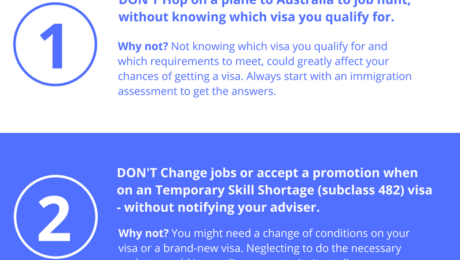
Do you want to live and work in Australia? Then we’re guessing you don’t want to do anything to jeopardise your chances.
That’s exactly why we put together a succinct guide to the three most important ‘don’ts’ you need to know about.
These are things you definitely should not do if you want to give yourself the best chance of realising your Australian dream.
Let us assess if you qualify to live and work in Australia
You’ll see in our guide that we say you should always start with an assessment. The reason for this is that an immigration assessment will reveal whether or not you’re eligible to live in Australia and which visa you may qualify for.
How do you go about assessing your eligibility? It’s as easy as booking a consultation call on our website.
Your guide
Below is your guide to our three definite ‘don’ts’. Save it and keep it close!

- Published in Immigration Advice, Our latest posts
Who can give you advice on Australian immigration?

 Let’s paint a picture here…
You’ve decided to uproot your family and move to Australia. You’re leaving loved ones and a life you know behind. You’re venturing into the unknown – and you’re going to spend a big chunk of your life savings doing so.
Given all this, who are you going to approach for advice on Australian immigration?
Should it be anyone? The answer is a definite ‘no’. ‘Anyone’ can’t accurately assess your chances of immigration. ‘Anyone’ won’t be able to explain the risks to you. ‘Anyone’ might very well take your money and disappear.
So who should you ask for advice on Australian immigration?
The golden rule
When it comes to moving yourself and your family halfway across the world to Australia, you should only deal with agents who are licensed and registered with the Migration Agent Registration Authority (MARA).
Only a licensed and registered agent is able to deliver the full set of services you’d require for a successful immigration:
- Explain the visa options available to you, assess your chances accurately and recommend a suitable visa option.
- Record your migration pathways and process in writing.
- Explain the risks involved to you.
- Ensure you know your rights with regards to complaints, billing and codes of conduct.
- Prepare documents for your visa application.
- Lodge a well-prepared application with all required documents, which can make it easier and faster to get a decision from the Australian Department of Immigration and Border Protection (IDBP).
- Contact DIPB or other organisations to discuss or ask questions about your application.
Now you’re probably asking yourself…
How do I know when someone is a registered immigration agent?
It is quite simple. Just go straight to the MARA website and click ‘Find an agent’.
From here you can do a search for an immigration agent by:
- Business location;
- Business name;
- The agent’s name; and/or
- The agent’s Migration Agent Registration Number (MARN). All fully licensed immigration agents for Australia has a MARN.
You can further verify an agent’s status by looking for their MARN number on their website. It is compulsory for all registered immigration agents for Australia to clearly display their MARN numbers on their website.
What does this mean? If you cannot see a MARN number on the agent’s website and you cannot find the agent on the MARA register, do not use their services!
It is illegal for any Australian-based company or individual to give you advice on Australian immigration or services related to visa applications if they are not registered.

Proceed with caution when approaching agents outside of Australia…
While the MARA website is an excellent tool to use to check whether a company or individual is registered, it unfortunately does present a shortcoming when dealing with agents outside of Australia.
This is because companies or individuals outside of Australia do not have to be registered with MARA.
Here is what you should look out for when dealing with agents outside of Australia – a DIBP number.
But it’s not what you think:
A DIBP number will often be presented as a type of license or endorsement from the Australian authorities.
It is not!
DIBP numbers are only issued for administrative purposes to companies and individuals outside Australia. This number does not entitle the company or person presenting it to you give advice on Australian immigration!
DIBP numbers expose you to huge risks
Many within the immigration industry has voiced their concerns about the provision of DIBP numbers, as it exposes the public to huge risks. The below is an extract from Australian Immigration News:
“When is the DIBP going to do something about unregistered practice? When is DIBP going to help prevent vulnerable consumers from being duped by the DIBP’s ‘Offshore ID’ status given out to unregistered agents? These ID’s are being used to sell a range of immigration services to unwitting visa applicants, not just students.
The ‘Offshore ID’ is paraded around as an endorsement tool by unregistered agents overseas looking to instill confidence and security in potential clients who may be seeking to migrate to Australia. The issue is that most of the time, the potential clients don’t even realise that there is such a thing as a RMA in existence on the planet. We can thank the OMARA and their $0.00 spend on advertising last financial year for that one. If migrants see a person with an ID, they, like me, would automatically assume that this person was a government endorsed immigration professional. Who knows what spin and lies are being sold to these unsuspecting visa applicants about how that ‘offshore ID’ was obtained.”
In short – do not deal with someone with only a DIBP number. This person is not under obligation to undertake qualifications, continue their professional development or prove their experience and cannot be held accountable. If anything goes wrong during your immigration process, there would most likely be very little you’d be able to do about it.
This is not where you stop your research into an immigration agent though…

Your options when it comes to licensed and registered agents
During your research you’ll come across these scenarios:
- Companies that employ the services of a consultant as an immigration agent.
- Companies that employ immigration agents, or that is owned or managed by immigration agents.
Which one should you pick for advice on Australian immigration? Ultimately the choice is yours, but let’s look at both scenarios:
- The company who employs an immigration agent as a consultant
Firstly it is important to note that licensed Australian immigration agents are permitted to act as a consultant to other companies and individuals.
Now that you know that, it is your responsibility to check that the immigration agent is in fact licensed and registered. As before, you can do this on MARA’s website, only this time you’re doing a search for the company’s name that you’re dealing with.
This search will reveal the licensed agent’s name and you should click on it to see what the business relationship is between the agent and the company. The search results will state when an agent is acting as a consultant.
Your search will also reveal whether or not the agent also run their own business or is involved in other businesses.
Now you’d want to move on to look at the relationship between yourself, the agent and the company you’re dealing with. Ask the following questions from the company:
- Who is giving you the advice?
- Is it in written form?
- Between which parties is your instructing mandate?
- Where is your money going – to the company or to the agent’s client account? (It should always be a client account!).
In contrast…
- The company who employs or is owned or managed by licensed immigration agents
Here the immigration agent works at the company you’re dealing with. This means you have a direct line to the agent. It also means the agent is dedicated to the company and their clients; the agent’s interests and attention are not divided.
This direct relationship means:
- You are getting advice on Australian immigration directly from the migration agent.
- You get your immigration advice in writing from the migration agent.
- The instructing mandate is between you and the licensed migration agent.
Your money is going to the company or licensed immigration agent’s account.
The biggest take-out here? Accountability, accountability, accountability! And when someone is accountable for a service they deliver, they are far more likely do their job to the best of their abilities.
Of course you should also still check the licensed immigration agent’s credentials before you take their advice on Australian immigration!
How does Intergate work?
Intergate is a company that employs licensed immigration agents. Our agents for Australia are Katrin Maja O’Flynn and Maike Versfeld. You can view their details on MARA’s website here and here.
As licensed agents, our agents adhere to Immigration Australia’s strict code of conduct. This binds us to certain ethical obligations, which means our approach to your immigration is logical and step by step:
- We do not demand large upfront payments from you or make false promises.
- We commence by assessing whether or not there is a visa option that you qualify for.
- Only if this outcome is positive, do we move on to items such as the Expression of Interest or IELTS and finally the compilation and submission of your application.
Sound familiar? Yes, it should. That’s everything we said earlier only a registered immigration agent can offer you – assess your chances accurately, recommend a suitable visa option, explain the risks involved, prepare and lodge your application.

Need more reasons to ask us for advice on Australian immigration?
How about the fact that as registered immigration agents we have professional indemnity insurance, which means you can sue if our migration agents get it wrong?
Or that as registered immigration agents we have access to LegendCom PAM resources, which means that we have access to the inner workings of the Department of Immigration and Border Protection?
Or that as registered immigration agents we adhere to strict accounting rules and keep your money in a client account until services are delivered?
But why don’t you call us and talk to us directly? You can contact us on +27 (0) 11 234 4275 8200 or +27 (0) 21 202 8200. Alternatively, simply send us an email.
In conclusion…
Emigration to Australia is huge investment for you and your family, emotionally and financially. Don’t be caught be bogus agents or agents outside of Australia who are not MARA registered. You’ll risk a lot and lose even more!
Ensure that you secure the services of a licensed and registered agent for Australia. In this way you’ll increase your chances of qualifying with the correct professional help and guidance and with the full reassurance of Immigration Australia.
- Published in Immigration Advice, Immigration to Australia
Immigration news to know

 Two articles to do with Australian immigration recently caught our attention and we want to share what we read.
Why? Because both the articles addressed the same theme – Australia is showing signs of reducing immigration numbers. In other words the number of visas extended to immigrants from overseas.
Immigration ‘ceiling’ vs ‘target’
The Australian migration program traditionally refers to immigration targets or ‘planning levels’, yet Immigration Minister, Peter Dutton, was recently quoted as referring to an ‘immigration ceiling’.
What is this all about?
The immigration department has always taken its responsibility of meeting immigration targets seriously. It is in fact rare for the department to miss the target with more than a small number of visas.
However, in the 2016/2017 year, the target was missed by 6400 visas – a stark contrast to previous years.
Why the big change? Because a mind shift from ‘target’ to ‘ceiling’ has started to take place in order to curb immigration numbers.
However, not everyone is on board. Many parliament members have argued against lowering immigration numbers.
Only future will tell which side wins the argument in the long run.
New Zealanders already in Australia taking visas that previously went to immigrants overseas
Forty four thousand places in Australia’s skilled independent visa program have traditionally gone to applicants who are mostly Asian and living overseas.
But now as many as 10 000 Kiwis who are already living and working in Australia will be part of this annual allocation.
The change is a result of a decision by the Government to merge a new Kiwi visa with the existing skilled independent program, without increasing the number of visas in the scheme.
The result?
Unfortunately the result of the change in strategy is that fewer visas are available to applicants from overseas, making it harder to enter Australia as an immigrant.
Stay up to date with immigration news out of Australia
Follow us on Facebook or LinkedIn to stay informed about immigration changes that could affect you. We post news as soon as it happens.
- Published in News, Our latest posts
The visitor visa for Australia

 Do you want to holiday in Australia? Ready to the see the sights and experience all the country has to offer?
Then you’ll need a visitor visa for Australia – or you might be turned away at the border after hours and hours of travelling.
Here’s we’ll cover what you should know about the visitor visa:
- What it allows you to do.
- Validity period.
- The processing times.
- Other travel documents you’ll need.
- The other visitor visa subclasses – subclass 651 and 601.
What does the Australian visitor visa (subclass 600) allow?
The subclass 600 lets you visit Australia for reasons such as:
- Holidays;
- Sightseeing;
- Social or recreational reasons; and
- Visiting relatives and friends.
How long will your visa be valid for?
The visitor visa for Australia is issued for up to three, six or 12 months at a time.
How long are the processing times?
You want to start planning your application well in advance! Australia’s Home Affairs notes that visitor visas under the Tourist steam takes between 19 and 27 days to process. In fact, 90 per cent of applications are processed in 27 days.
What other travel documents should you have?
Overseas visitors must present the following documents to officers in immigration clearance in addition to a valid visa:
- Valid passport or other acceptable travel document.
- Complete and signed Incoming Passenger card, including health and character declaration.
What other visitor visa subclasses are there?
There are two other visitor visa subclasses – subclass 651 and 601. These subclasses are only open to passport holders of certain countries.
Subclass 651 – eVisitor visa:
This visa is free to qualifying applicants and only takes between 1 and 2 days to process.
See a list of eligible countries here.
Subclass 601 – Electronic Travel Authority visa:
The subclass 601 visa permits you to visit Australia as many times as you want, for up to a year, and stay up to three months for each visit.
The average processing time is less than a day, but you have to pay a service fee of AU$20.
See a list of eligible countries here.
Need help with your application for a visitor visa for Australia?
Our immigration agents can help you apply for a visitor visa (subclass 600). All you have to do is either call us on +27 (0) 11 234 4275 or send us an email.
Remember, you can expect to wait up to 27 days for your visa, so contact us sooner rather than later!
- Published in Our latest posts, Short-term Visas
The Contributory Parent visa (subclass 143)

 Australia’s Parent Visa can take up to 30 years to process! Thankfully there is an alternative – the Contributory Parent visa (subclass 143).
While this Parent subclass is not a quick solution by any stretch of the imagination, as it takes up to 40 months to process, it’s the preferred alternative to the Parent Visa for many applicants. Especially as the subclass 143 visa also allows you to stay in Australia on a permanent basis.
Let’s see if you stand a chance to qualify for the Contributory Parent visa:
Main eligibility criteria
You must have a child who is:
- An Australian citizen;
- A permanent resident; or
- An eligible New Zealand citizen.
You must have a sponsor
You must be sponsored for this visa. Usually you would be sponsored by an eligible child. If your child is under 18, you can be sponsored by an eligible relative or community organisation.
Health and character requirements
You must meet Australia’s health and character requirements
Other eligibility criteria
You’ll have to meet the balance-of-family test unless:
- You currently hold a Contributory Parent (Temporary) visa (subclass 173).
- Your Contributory Parent (Temporary) visa (subclass 173) ended in the 28 days immediately before you apply for a Contributory Parent visa (subclass 143).
- Your subclass 884 visa ended more than 28 days before you apply for a Contributory Parent visa (subclass 143) but you can show compassionate and compelling reasons to be considered to still hold the visa.
Other important information to note
As mentioned at the start, the Contributory Parent visa (subclass 143) lets you stay in Australia indefinitely. In addition, this visa enables you to:
- Work and study in Australia.
- Enrol in Medicare.
- Sponsor eligible relatives for permanent residence.
- Travel to and from Australia for five years.
- Apply for Australian citizenship, if you’re eligible.
Assess your eligibility for a Contributory Parent visa
Would you like to apply for a Contributory Parent Visa? The first step is finding out if you qualify. Do this by booking a consultation call with our licensed advisor on our website. You’ll not only discover your visa options for Australia, you’ll also learn how the immigration process works and what the costs are.
- Published in Immigration Advice, Our latest posts
Driving in Australia with an overseas licence

 Thinking of making Australia your home? Then you’re probably wondering if driving in Australia with an overseas licence is allowed.
The short answer? Yes.
However, laws and driving regulations differ from state to state in Australia. We’ll break down the basics for you, but first let’s elaborate on the short answer above.
Can I drive in Australia on my overseas licence?
You are allowed to drive on an overseas licence in most Australian states – as long as your licence is current.
Furthermore, you can only drive vehicles which your overseas licence authorizes you to drive and you must drive according to the conditions on your overseas licence.
State and territory laws for driving in Australia with an overseas licence
There is a lot of information around laws and driving regulations in Australia! Thus, as mentioned, we’re only giving you the basics here. However, we don’t leave you with only the basics, we’ll also supply links to detailed information.
Australian Capital Territory (ACT)
As an overseas licence holder driving in ACT, you must carry your:
- Foreign driver licence written in English; or
- International driving permit accompanied by a foreign driver licence; or
- Foreign driver licence, which is not in English, accompanied by an official English translation. The only acceptable translations are those issued by the National Accreditation Authority For Translators and Interpreters or an Australian Institute of Interpreters and Translators accredited translator.
Getting an ACT licence:
You must obtain an ACT driver’s licence within three months of taking up residency in the ACT.
New South Wales (NSW)
You can use your overseas licence for a maximum of three months. Thereafter you must have a NSW licence.
Your overseas licence will be taken into account when you apply for a NSW licence, but you may still have to pass medical and driving tests.
Northern Territory (NT)
As in ACT and NSW, you must change from an overseas licence to a NT licence within three months of living the Northern Territory.
Transfer of an overseas licence:
You can transfer your overseas driver licence (Class C) or motorcycle licence (Class R) to the NT. To do this, you’ll have to visit a Motor Vehicle Registry (MVR) office.
You may or may not have to do tests depending on where in the world you are moving from.
Queensland
You are allowed to drive in Queensland if you have a valid overseas licence. However, once you have a Queensland licence, you will no longer be able to use your overseas licence.
South Australia
If you become a permanent resident of South Australia, you must get your South Australian driver’s licence within 90 days.
To find out if you can transfer your licence for the same class of licence in South Australia, complete the South Australian Government’s question list.
Tasmania
You can drive in Tasmania on your overseas licence if you have a:
- Temporary visa; or
- Permanent visa that has not been issued more than 3 months,
as long as:
- Your overseas licence remains current.
- You have not been disqualified from driving in Tasmania or anywhere else in the world.
- Your licence has not been suspended or cancelled.
- You have not been issued a Tasmanian licence.
- Your carry your licence with you. If it is not in English, you must also carry an International Drivers Permit or an official translation.
Victoria
Victoria has different rules for temporary and permanent visa holders:
Temporary visa holders:
- You do not have to get a Victorian driver licence and/or learner permit.
- You can drive using your current overseas driver licence for the length of your stay.
- Your licence must be in English or accompanied by an English translation or International Driving Permit.
Permanent visa holders:
If you have a permanent visa, you may drive on your overseas driver licence if it’s in English or accompanied by an English translation or International Driving Permit for:
- Six months from the date you first entered Australia, if your permanent visa was issued before you entered Australia; or
- Six months from the date when the permanent visa was issued, if the visa was issued while you’re in Australia.
If you want to continue driving in Victoria after this 6-month timeline, you must get a Victorian driver licence.
Western Australia
If you hold a permanent resident visa and are living in Western Australia, you can drive with your current overseas licence for up to 3 months.
During this time, you will need to apply for a WA driver’s.
If you have held a permanent visa for 3 months or more whilst residing in Western Australia, or your overseas driver’s licence has expired or been disqualified, you cannot drive on your overseas licence.
Recapping…
Driving in Australia with an overseas licence is allowed, but only for three months in most cases. Thereafter, you’ll have to transfer your licence. Depending on where in the world you’re from, you may have to do tests to gain an Australian driving licence. Once you have the licence, you’re may no longer drive on your overseas licence.
- Published in Life in Australia, Our latest posts